
Last updated October 31, 2026
 Home additions & ADU
 Kitchen remodeling
 Bathroom remodeling
 Roofing
 Windows & doors
 Driveway & pavers
 Fence
Free written scope consultation - allowances, timeline, and change-order rules on paper before a single trade is scheduled
Seasonal Construction Care for Foster City: Year-Round Homeowner’s Guide
Foster City averages 261 sunny days a year, yet sits in a persistent marine layer corridor that changes how a house ages in ways standard California maintenance guides miss entirely. South-facing siding bakes under real UV stress while north-facing walls stay damp long after rain stops, sometimes on the same structure, at the same time. This guide walks through what Foster City weather actually does to a home, quarter by quarter, and what to do about it before small issues become structural problems. By the end, you’ll know when to inspect what, why the lagoon adjacency changes drainage math, and how a single annual walkthrough can catch both interior and exterior issues before they compound.
Quick Answer
Seasonal home maintenance in Foster City means timing inspections and repairs around four distinct micro-conditions: post-rain drainage audits in winter, pre-fog weatherstripping in spring, dry-window roof membrane work in summer, and pre-rain hardscape slope checks in fall. The goal is catching moisture movement, UV damage, and drainage shifts before they require major construction intervention. A systematic quarterly walkthrough takes about two hours per season and prevents most costly structural surprises.
Styles & brands we work with
Table of Contents
- Q1 (January – March): Post-Rain Drainage Audit and Foundation Crack Mapping
- Q2 (April – June): Weatherstripping Before Fog Season and UV Paint Checks
- Q3 (July – September): Roof Deck and Flat Roof Work During the Dry Window
- Q4 (October – December): Pre-Rain Prep for Lagoon-Adjacent Drainage
- How a Full-Scope Contractor Bundles Seasonal Observations
- Material Choices That Reduce Foster City Maintenance Load
- Common Mistakes to Avoid
- When to Call a Professional
- Frequently Asked Questions
- The Bottom Line
Q1 (January – March): Post-Rain Drainage Audit and Foundation Crack Mapping
Foster City’s winter rain pattern is deceptively mild on paper, around 18 to 20 inches annually, but it arrives in bursts that saturate the clay-heavy soils beneath the lagoon-adjacent neighborhoods slower than they drain. Once rain stops in March, soils begin drying unevenly. That drying window is exactly when existing foundation movement becomes visible or gets masked by soil shifting back into place. We pay close attention during this quarter because problems caught in January through March are the cheapest to fix before spring projects begin.
Start with the drainage audit. Walk your property during or immediately after a real rain event, not a drizzle. You want to see where water actually flows, not where you assume it flows.
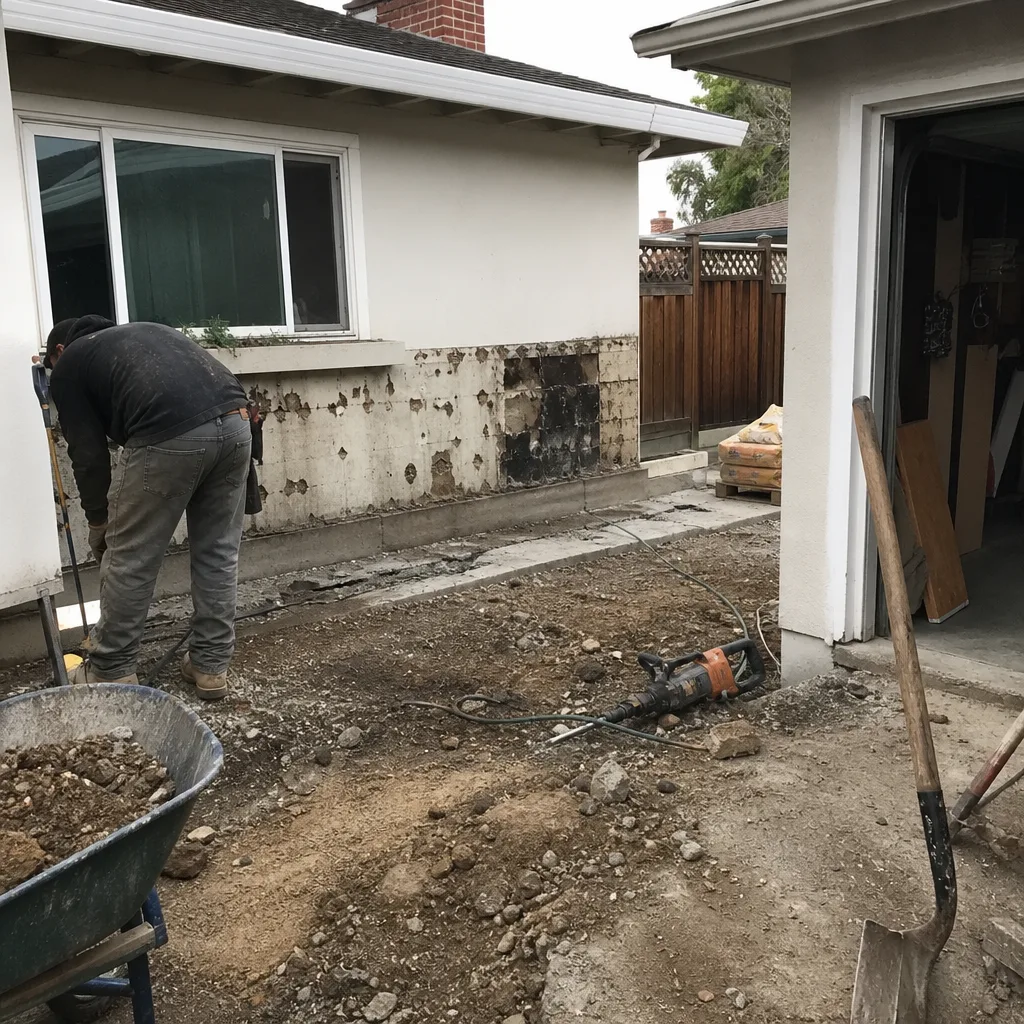
- Check every downspout terminus. Water should discharge at least four feet from the foundation. In Foster City lagoon-adjacent lots, many homes have downspouts that empty onto flat concrete patios with no slope. If water pools, it’s working against you. Extensions are a fifteen-dollar fix that prevents thousands in foundation repair.
- Inspect the soil line against the stem wall. Look for gaps, a sign soil pulled away during dry spells or washed out during rain. Gaps let water travel straight down the foundation face instead of away from it.
- Map any new cracks with painter’s tape. Mark the date on the tape. If the crack widens by more than 1/16 inch in eight weeks, call a contractor. Mineral soils under Foster City expand when wet and compress when dry, and this seasonal pumping is the primary cause of cosmetic cracking here, but width change distinguishes cosmetic from structural.
- Check crawlspace or garage slab for efflorescence. White powdery residue on concrete means moisture is wicking through. In Foster City, this often traces back to rain splash from short overhangs or gutter failure rather than a high water table.
One pattern we see repeatedly in Foster City is homeowners mistaking dry-season foundation cracks for new problems, when they were actually created months earlier. Catching them in Q1, while soil is still wet and the crack is at its widest, gives you the clearest picture. Paint over the tape once you’ve confirmed stability, and log it for next year’s comparison.
See the difference
 Before
 After
 Before
 After
 Before
 After
Quick Tips for Q1
- Clean gutters before March’s last heavy rain, not after it.
- Test sump pump if your home has one, lagoon-adjacent lots sometimes surprise owners with standing groundwater.
- Check window wells and stairwell drains for debris from winter winds.
- Run bathroom exhaust fans for a full cycle and check for attic condensation, wet winters reveal ventilation gaps quickly.
For homeowners planning a larger remodel or working with a general contractor in Foster City, Q1 is the right time to schedule initial walkthroughs. The moisture picture is clearest in winter, and that informs scope decisions before dry-season construction begins.
Q2 (April – June): Weatherstripping Before Fog Season and UV Paint Checks
Foster City’s summer begins with fog. May and June bring persistent marine layer mornings that burn off by afternoon, creating humidity swings that stress seals and gaskets on every opening in the home. If your weatherstripping is degraded, you’ll feel it as drafts before you see it as wear. The fix is cheap. Ignoring it means running HVAC harder through the three most comfortable months of the year, which is exactly backwards.
The bigger hidden cost in Q2 is UV. By late May, the sun angle has shifted high enough to hit south and west elevations hard, and Foster City’s reflective lagoon light adds a secondary UV bounce that strips paint faster than inland California homes experience. We inspect paint adhesion on south and west walls every April, looking for:
- Chalking. Run your hand along siding. Chalky residue means the paint film is breaking down. It’s still protecting the substrate below until it’s gone, but you’re now on a countdown.
- Cracking or peeling at joints. Particularly where siding meets trim, expansion rates differ and paint fails there first.
- Bubbling on horizontal surfaces. This indicates trapped moisture from the rainy season, which means water got behind the paint film somewhere.
- Fading asymmetry. South and west walls fading faster than north and east is normal in Foster City. But sudden fading on one wall can indicate reflected UV from a new neighbor window, a newly paved driveway, or even a parked boat on a trailer acting like a mirror.
Weatherstripping replacement is straightforward for most homeowners: pull the old strip, clean the channel, press in new foam or vinyl gasket material. But door thresholds are trickier. If the door sweeps on the threshold but gaps appear at the corners, the threshold may need shimming or replacement. We suggest doing this work in April, before the fog season in May and June locks in the dampness that accelerates further seal degradation. A weather-tight door in July is not an achievement, it’s baseline.
For homes undergoing home remodeling in Foster City, Q2 is ideal for exterior scope decisions. You can see paint failure clearly, drainage reality is fresh from Q1 observations, and you still have the entire dry season ahead for execution.
Q3 (July – September): Roof Deck and Flat Roof Work During the Dry Window
Foster City has exactly one reliable dry window for roof work: July through mid-September. Rain is rare, fog lingers offshore more than it pulls inland, and the consistent heat cycle lets membrane products cure properly. This is the only window where roof repairs, resealing, and deck membrane replacement can be scheduled without rain risk, and every roofer in the Bay Area knows it. Book early.
For the irregular roofs common in Foster City’s planned neighborhoods, many homes have flat or low-slope sections over garages, porches, and bonus rooms, the inspection sequence matters:
- Clear debris first. Flat roofs collect leaves from ornamental trees and wind-blown debris. Debris holds moisture against the membrane and accelerates deterioration.
- Check all penetrations. Pipe boots, vent stacks, skylight curbs, and HVAC penetrations are where most flat roof failures start. Sealant cracks around these are the number one source of flat roof leaks we see in Foster City.
- Inspect membrane seams. Look for lifting, bubbling, or visible separation. A membrane that’s lifting at the seam is going to leak in the next rain cycle. Repairs now are hundreds, not thousands.
- Verify drainage slope. Flat roofs aren’t actually flat. They should have a 1/4 inch per foot slope toward roof drains or scuppers. Standing water 48 hours after rain means the slope has failed, and that’s a structural issue over time.
- Check edge metal and flashing. Wind-driven rain comes at edges from unusual angles in Foster City’s exposed lagoon corridors. Loose or lifted edge metal lets water run backward into the roof assembly.
The under-roof deck inspection matters just as much. Go into the attic on a sunny July afternoon, not morning. You’re looking for two things: daylight gaps at any roof penetration, and dark staining on the underside of the roof sheathing. Dark staining means moisture has been getting in historically, even if the current leak seems sealed. If you see both daylight and staining together, active water entry is happening.
Flat roof repairs done in Q3 have a distinct advantage: the membrane has months of warm dry weather to fully cure and bond before the first rain in late October. Repairs rushed during winter hold about as well as you’d expect. If you’re planning a home renovation in Foster City that includes roof scope, insist the roofing work gets sequenced for the dry window, even if that means adjusting the project timeline.
Q4 (October – December): Pre-Rain Prep for Lagoon-Adjacent Drainage
Foster City’s drainage patterns are different from neighboring San Mateo and Belmont because the entire city was engineered on dredge fill with a managed lagoon system. Runoff doesn’t just flow downhill to a storm drain. It flows toward the lagoon, and property grading matters more here than on natural terrain. Pre-rain preparation in Q4 is about making sure water leaves your property the right way, to the street or storm drain, not toward the lagoon edge where it can undermine soil and saturate your foundation.
Start with hardscape slope verification. Walk every paved surface with a level:
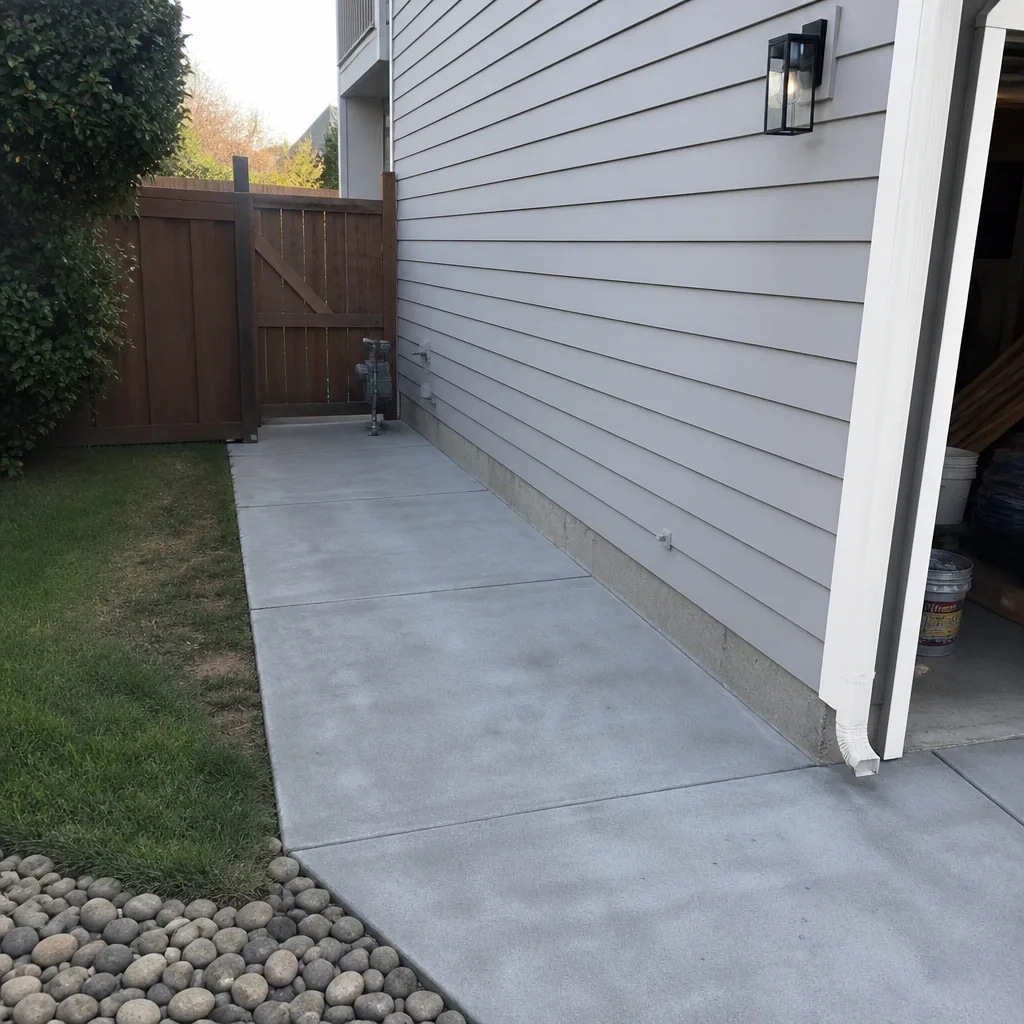
- Driveways and walkways should slope away from the house. A minimum of 1/4 inch per foot. If the slab has settled and now slopes toward the foundation, water is being delivered straight to your stem wall every time it rains.
- Patios and pool decks need positive drainage too. In Foster City’s mild climate, people spend more days outside, and flat or reversed patio slope is a common source of interior water intrusion.
- Check downspout routing. Every downspout should discharge to a splash block, a buried drain line, or an extension that carries water to a graded area. Routing downspouts toward the lagoon side of your property is never acceptable here, it’s how you end up with a soggy yard and a failing retaining wall.
- Inspect catch basins and area drains. Many Foster City homes have drains that connect to the city’s storm system. Clear debris now, before leaves start falling en masse, so the system is ready when the first real storm hits.
Gutter cleaning in Q4 is non-negotiable. Wait until most leaves have fallen, then clean. For single-story Foster City homes, a sturdy ladder and a hose attachment do the job in an afternoon. For two-story sections, rent a standoff stabilizer or hire it out. Clogged gutters overflow against fascia boards and down the side of the house, which starts a slow rot process that most homeowners don’t notice until they’re already paying for repair. Check that gutter hangers are tight and that seams aren’t separating while you’re up there.
Quick Q4 Checklist
- Clean gutters and downspouts after leaf drop.
- Verify downspouts extend at least four feet from foundation.
- Check hardscape slope away from house on all four sides.
- Clear area drains and catch basins.
- Inspect roof for lifted shingles or membrane concerns before rain.
- Test exterior doors and windows for air leaks that let in moisture.
- Confirm all exterior vents (crawlspace, attic, bath) have intact screens to keep rodents out during cooler months.
For homeowners who’ve noticed recurring moisture in one corner of the house every winter, Q4 is the time to trace the source. We’re often called in during January or February when the leak is active, but the easier fix was available in October when everything was dry and accessible.
How a Full-Scope Contractor Bundles Seasonal Observations
Here’s what we’ve learned doing this in Foster City for years: the biggest maintenance failures aren’t caused by dramatic events. They’re caused by small observations that nobody connects. A cracked caulk line near a window. A downspout that’s been discharging against the foundation for three years. A section of fence posts with rot at the base. Individually, each is minor. Together, they paint a picture of how the house is actually performing, not how you hope it’s performing.
This is where a single full-scope walkthrough beats calling separate specialists. When one contractor walks the full property, interior and exterior, patterns emerge. A moisture stain on the ceiling traces back to a roof issue. A sticking door traces back to a foundation shift noticed months earlier. A drafty kitchen traces to the same weatherstripping failure that’s letting moisture into the wall cavity. The Ashford Contractors home team performs this kind of annual walkthrough for Foster City homeowners, and the value isn’t in any individual observation, it’s in the synthesis.
A proper annual walkthrough covers:
- The building envelope: roof, siding, windows, doors, weatherstripping, flashing and sealant at all penetrations.
- Moisture management: gutters, downspouts, grading, hardscape slope, crawlspace humidity and drainage patterns.
- Structural indicators: foundation cracks, drywall cracking, door and window operation, floor slope and grout line separation.
- Mechanical basics: water heater condition, HVAC filter access, exhaust fan operation, sump pump test, and any visible plumbing or electrical concerns that warrant a specialist.
- Exterior finishes: paint adhesion, hardscape joint condition, fence post stability, and deck structure if present.
- Following generic “California seasonal maintenance” checklists. Foster City’s damp north, fried south, zero freeze-thaw, and lagoon drainage patterns don’t match Sacramento, Fresno, or even San Jose. Using advice from inland California climate zones means doing the wrong thing at the wrong time.
- Ignoring the north side of the house. Homeowners constantly inspect the sun-exposed south and west elevations because that’s where fading is visible. But the north side is where mold and dry rot start in Foster City’s fog pattern. Inspect where you don’t see problems, not just where you do.
- Waiting until summer to inspect the roof. By July, you’ve already missed half the dry window. Roof inspections are most productive in May, when the weather has stabilized but there’s still time to schedule repairs before the first late-fall rain.
- Cleaning gutters only in fall. Foster City’s ornamental trees drop material year-round, and the spring wind cycle fills gutters with pollen, blossoms, and dust. Clean twice yearly: once after leaf drop in late fall, once in late spring after the bloom cycle.
- Treating every foundation crack as an emergency. Foster City’s clay-heavy dredge fill soils move seasonally, and most cracks are cosmetic. But treating the cosmetic ones as “just caulk it” without tracking movement means missing the one crack that actually indicates a structural shift. Tape, date, measure, compare.
- Routing downspouts toward the lagoon side of the property without checking grade. Water should flow to the city storm system, not your neighbor’s yard or the lagoon edge. Improper routing creates erosion and soggy yard conditions that no amount of lawn care can fix.
- Deferring weatherstripping replacement because “it’s not hot or cold enough to matter.” Weatherstripping isn’t about temperature in Foster City. It’s about moisture. A failed door seal in May means humid fog air gets pulled into the wall cavity every night, accelerating mold growth you can’t see yet.
When observations from different systems are bundled by one home renovation contractor in Foster City, the homeowner gets prioritization as part of the package. Not a list of twenty things to fix in a panic, but a sequence: what’s urgent, what’s fine for now, what should be grouped with a future remodel. Most maintenance issues can wait a season. A few can’t. The difference usually becomes obvious when you look at the full picture.
Material Choices That Reduce Foster City Maintenance Load
Foster City’s micro-climate responds best to materials that handle moisture without demanding constant attention. When homeowners ask us which materials to choose for long-term low-maintenance performance here, our recommendations reflect what actually holds up in the fog-plus-sun cycle.
Concrete and hardscape: We source pavers from Cambridge Pavers for driveway and patio applications where joint stability matters. Their interlocking system handles the minor soil movement that comes with Foster City’s wet-dry cycle better than poured slabs in many cases. For concrete work, we use Quikrete and Sakrete products for repairs, resurfacing and post-setting. Both offer products specifically formulated for coastal exposure, and the product consistency matters when you’re doing repair work alongside existing concrete.
Exterior finishes: James Hardie fiber cement siding outperforms wood in Foster City’s damp north-side conditions. It doesn’t rot, doesn’t warp with moisture swings, and holds paint longer than wood because the substrate is dimensionally stable. Where wood trim exists, check it twice as often. It’s the first thing to fail in marine layer exposure.
Door and window seals: Pay extra for marine-grade weatherstripping when replacing. Standard foam degrades faster in constant humidity cycling. The cost difference is negligible compared to the replacement labor when cheap stripping fails after two seasons.
Roof membranes: For the flat roof sections common on Foster City homes, choose a high-quality white or light-colored membrane. Reflective surfaces reduce heat absorption during sunny summer days and reduce the expansion-contraction cycle that eventually breaks down seams. Dark membranes cook in the sun and fail sooner, particularly on south-facing roof sections.
The product discussion matters because maintenance is not just about what you do, it’s about what you installed in the first place. A homeowner who chooses materials that fight Foster City’s conditions will spend more every year on upkeep than one who chooses materials that accommodate them. The brand options are broad, and the right answer depends on exposure, budget, and whether the home is a long-term hold or a five-year property. A full-scope general contractor in Foster City who works across 50+ manufacturers can match material to micro-condition rather than defaulting to whatever’s cheapest on the shelf that week.
Common Mistakes to Avoid
When to Call a Professional
Call a professional when you see active water intrusion anywhere inside the home, when foundation cracks widen beyond 1/16 inch between measurements, when you can see daylight through your roof deck, or when a door or window suddenly binds and won’t operate smoothly. These are indicators that a system has moved from maintenance to repair. Also call a pro when flat roof membranes show bubbling or seam separation, because DIY patches on a flat roof in Foster City rarely survive a full rainy season. For the drainage issues specific to lagoon-adjacent lots, like reversed slope on a patio that sends water against the foundation, the fix often requires cutting and re-pouring concrete or regrading soil, which is real construction scope, not a Saturday project. Ashford Contractors offers free estimates in Foster City, call (877) 752-3868. Full-scope means one contractor evaluates the moisture, the structural, and the finish issues together, and gives you a prioritized plan. That’s the service we provide in Foster City, and the walkthrough is genuinely free.
Frequently Asked Questions
Do a full walkthrough four times annually, once per quarter, with a more detailed structural review annually in Q1 or Q2. The quarterly walks catch seasonal issues like gutter debris and seal failures; the annual deep review maps foundation movement and roof condition. Call us at (877) 752-3868 and we’ll walk your Foster City property with you at no charge.
July through mid-September is the only reliable dry window for roof membrane work and resealing in Foster City. Book contractors early, this window fills fast across the Bay Area. Call (877) 752-3868 in May or early June to secure a dry-season slot.
Yes. Foster City is engineered on dredge fill with a managed lagoon system, which means property drainage must route to the street or storm drain, not toward the lagoon edge. Improper routing causes soil saturation, erosion, and retaining wall issues specific to lagoon-adjacent lots.
Foster City’s persistent marine layer keeps north-facing surfaces damp for hours longer than south-facing surfaces, which receive direct sun and dry quickly. This creates prime conditions for mold and mildew growth on north walls, particularly in shaded areas. Improving air circulation and checking for vegetation too close to the wall helps, as does addressing any rain splash from missing gutters or short overhangs.
Mark the crack with painter’s tape, date it, and measure the width. If it widens more than 1/16 inch in eight weeks, you have active movement that warrants professional evaluation. Foster City’s clay-rich dredge fill soils move seasonally, and most cracks are cosmetic responses to that cycle, but consistent widening is the signal that separates cosmetic from structural. Call (877) 752-3868 and we’ll assess it during a free estimate visit.
Most weatherstripping replacement is straightforward DIY work for doors and windows with standard channels. But if the door or window frame itself has shifted, or if you’re seeing moisture staining around the opening, the seal failure is a symptom of a larger issue. We handle weatherstripping as part of broader home remodeling work in Foster City, and we’re happy to evaluate your situation without charge.
The Bottom Line
Foster City homes don’t fail all at once; they fail in the places nobody looks until it’s too expensive to ignore. The north-facing wall that never dries out. The downspout that’s been dumping against the foundation for four years. The flat roof seam that lifted during one summer heat cycle and never got resealed. None of these are dramatic. All of them are fixable if caught during the right quarter. The rhythm is simple: drain and map in winter, seal and inspect in spring, roof and membrane work in summer, prepare before the rains in fall. One walkthrough per quarter, one annual deep review, and a material selection process that doesn’t fight the marine layer. That’s the whole system. If you need help seeing it all at once, call us at (877) 752-3868; one contractor, every system, and the estimate is free.
Written by the team at Ashford Contractors, serving Foster City since 2013.